Showing posts with label film. Show all posts

Saturday, July 24, 2010

Construct


Inception is a vanity project. Eight years is far too long to develop a script for a movie. I fear that in that time Christopher Nolan became uncompromisingly attached to the material and unhealthily obsessed over plot intricacies. I say this with a negative connotation because watching Inception feels like reading a book, except of course you can’t open to any page or reread any passages (though you’d want to). It is literate rather than musical, or if musical at all, is a symphony written, conducted and performed by robots.

If nothing else, Inception is a direct conduit into the thought processes of a particular type of person. People in literary professions or even just Creative Writing/English majors often like Nolan’s work, and he indeed probably would make a good novelist. It is clear enough that he is meticulous and calculating regarding his scripts. However, as a film director, as a visual storyteller, I can’t help but find him lacking. A film’s “literature” (whenever I say this regarding movies, I’m referring to the ins and outs of its narrative), as I mentioned in my Shutter Island review, doesn’t interest me much. Film is a medium of tonality and style, i.e. storytelling through aesthetic choices rather than literary ones.

I’d argue that Inception totally fails as a motion picture because it was such a literal handling of inherently abstract material. Its aesthetics were, without warrant, quite similar to those of The Dark Knight: urban, gritty, and hyper-realistic. I can’t be so arrogant as to assume Nolan’s intentions, but portraying things as vague and transformative as dreams in such a concrete way is at the least a haphazard clash of fundamentals. This isn’t even my real issue, though, rather it is the standardization of dreams. Dreams are deeply personal experiences; to dream is to meditate on one’s desires, fears, even fetishes. Inception turns dreams into a shared experience, into a virtual space that can be tread by anyone. Inception turns dreams into public transportation. While I’m willing to acknowledge that this could have in fact been the Point, as in blurring (actually more like erasing via Etch-A-Sketch) the line between dreams and reality, such irresponsible invasion of the subconscious is a premise that I just can’t get behind.

Vanity projects do have incredible value on one level, though: the unequaled insight into the mind of the author. Inception’s story deals with a man lost in the labyrinth of his own surrealties, the ever-encroaching walls of which haphazardly realign and rearrange the rules of reality. Even the film’s aspect ratio (2.35:1) felt claustrophobic and awkward, furthering the angular and mathematical madness. This is admittedly fascinating if interpreted as Nolan subconsciously reconstructing his mind onto film, but for me as a viewer, it was a nightmare. Journeying into the subconsciousness of another is truly traumatic. It also, again, directly conflicts with the film’s narrative, where the characters hop from brain to brain like visiting each others’ apartments. For all intents and purposes I hated Inception and found no joy in its viewing. I liken the experience to someone violently shaking me and yet somehow me being utterly bored by the action. And yet… it is such an ambitious film, and I have no reservations about assuming it was a project of supreme personal significance. I hope that, like Inception’s protagonist, somewhere amongst, underneath, and inside his convoluted construction, Christopher Nolan found what he was searching for. I sincerely do.


Sunday, July 4, 2010

Reviewy Things 3

I can't bring myself to expand these into "full" reviews for whatever reason. However, I do think they're pretty substantive even in their teeny states. Not enough substance for substance abuse, right?

Right?

Kirby and the Amazing Mirror


I want to assign some meaning of versatile teamwork, of the ever-changing lineups and personalities of band members, maybe (of Paul McCartney and Wings, maybe); and though I may not be wrong, sometimes a pink blowjob master is just a pink blowjob master.


The Last Airbender


I'm glad this movie exists. Is it a failure as an adaptation, and as a movie in its own right? It just may be, but don't hold that against it! The Last Airbender is a whiff; a grand, baroque, beleaguering swipe at brilliance whose inevitable crash back to Earth perhaps resulted in the Littlest Grand Canyon. This movie is Charlie Brown's lunge at the football.

Tuesday, May 11, 2010

Penis


I found Iron Man 2 to be more concerned with the “Man” part of Tony Stark than anything else. He’s getting on into middle age. He’s coming to grips with his distant father and the legacy of his work and his company. He gets drunk and makes a fool of himself at his birthday party. The classic man at the crossroads of his life, truly faced with mortality (off in the distance, but by all means visible) for the first time. How much Iron does it take for one Man’s defenses to make it through life intact?

Not much. Jon Favreau can’t direct action, for one. There is not a single tense moment in the entire film. His background is comedy, and the film is indeed funny and has some pretty sharp, if light, satire. Tony Stark consistently mutes the nonsense jabber of nonsense politicians as they quarrel over the ethics of the Iron Man suit (they call it a "weapon"). Bill O’Reilly even has a cameo. His muting is welcome. If the film’s climax had presented the moral dilemma of a man at ends with his reputation, fighting for more than the protection of “the people” and “the girl,” then perhaps I could view this sequel as more than just that. If the audience was brought to some greater understanding of fame and public image versus private desires (really now, Stark’s narcissism and yet his need to innovate, to trail-blaze, are all the inspiration a screenwriter should need), then this could very well have been the best superhero film since Spider-Man 2. But what’s opted for is an even shorter and more pointless final battle than what was slapped together in the original Iron Man. Another villain is totally wasted. (I’m guessing due to the obscene special effects budget. Have a look at all the effects companies credited.) It’s a shame, because this one’s not bad. Ivan Vanko is a disgruntled victim of Stark Industries’ reckless management in the past. The best action scene of the movie is when Stark and the Vanko first meet. Iron Man gets his ass kicked. He meets his match. This should have resulted in a completely crippling blow to Stark’s over-inflated ego. Instead, the villain is thrown to the curb. But I wouldn’t worry; we’ll have a brand new one in the inevitable Iron Man 3.

Maybe I’m missing the point, though. Maybe Iron Man 2 is a cleverly cerebral celebration of all things macho. Big guns, sexy women, the dichotomous state of mind that is the innate need to protect and to imperialize… there’s even a black/white buddy cop motif and an AC-don’t forget the lightning bolt-DC soundtrack. Yes, perhaps the film’s obsession with being bigger, badder, and betterer than the other guy is the most accurate representation of the male id ever put to screen.

But I doubt it.

Saturday, March 13, 2010

Western Funeral


Once Upon a Time in the West is the greatest Western ever made, and by extension, one of the greatest films ever made. Actually, even though I have a strong hatred for such silly hyperbolic phrases (despite said phrases having become common subjects and methods of classification), Once Upon a Time in the West may be the greatest Western of all time. There are grounds for this. First of all, I doubt there will ever be a director who loved or understood the genre more than Sergio Leone. The Italian's fascination with and awe of American culture was epitomized by the glorification of the time period; the Old West had become modern mythology. There is a chivalry to the cowboy, and a fantasy to the frontier. Leone idolized it all.

"In my childhood, America was like a religion. Then, real-life Americans abruptly entered my life in Jeeps and upset all my dreams."

That's the other reason a better Western is unlikely to ever exist, and what the film is really about: the death of the myth. West was almost topical in the way it combined and referenced so many of the genre's staples. The opening credits sequence re-imagines the train scene from High Noon, except in West, the three characters waiting for the train are gunned down within minutes. There is even a small reference to Leone's previous film (and one of his three masterpieces), The Good, the Bad and the Ugly. One of the three men famously filled the frame of that film's opening shot, and remember the stray dog that intercut that first shot? He's back, too. Legend has it that Leone even intended Clint Eastwood, Lee Van Cleef, and Eli Wallach to play the three men at the beginning of West. The shock of their deaths so early in the film would have perfectly symbolized the deconstruction of the genre, especially since Van Cleef was also one of the original three in High Noon. The man knew what he was doing.

Friday, February 26, 2010

Institutionalization


Shutter Island is a film about a man at war with himself. The mental hospital in which the story takes place is said to have been constructed during the Civil War, and the freakishly enigmatic "Ward C" (where the really crazy ones are kept) was a fort in that war. Ben Kingsley as Dr. Cawley even remarks on the state of psychiatric study: a polarized philosophic mess of old and new ideologies. Internal conflict. So, it's the usual for a psychological thriller, except this time, it's Scorsese-fied.

Scorsese and DiCaprio have made a super-charged genre picture. Because of this, some will find the film cliche and too close to the mark. They wouldn't be wrong, but they'd be missing the point. Nitpicking the plot of any film is a tremendous waste of time. A film's aesthetics are far more important than its literature, and that above all else seems to be the focus of Shutter Island. Sure, you could list off references to past thrillers (I even flashbacked to Skull Island, of all things, during the opening scene), most notably those of the master himself. Both Scorsese and DiCaprio have cited Vertigo as a major influence, and indeed, the tale of a haunted man warped by his memories of a (blonde) woman isn't simply similar. But also remember Hitchcock's mantras of cinema: not as "a slice of life, but a piece of cake," and "technique over content."

And oh, such technique, such style. Scorsese has long been acknowledged as a wizard of of the camera, but I find his utilization and mastery of modern film making techniques downright astounding, especially his humblingly efficient use of computer generated special effects. Can you imagine The Aviator without the glossy galvanization of the crash sequence, or the ridiculous realization of the H-4's liftoff? I can't. Shutter Island is not without equally impossible visual wonders. The psyche is home to many elaborate and surreal dream sequences (or hallucinations... who knows!), including the converged perceptions of misrememberings, and the confetti-like, atmospheric, ashy remains of a fire victim, not really affected by gravity, but listless and tormenting.

Also, maybe it was just me, but I found this film to be a joyous playground of motifs. The final shot is a quiet pan over the island's craggy, New England cliffside, settling on the lone image of a lighthouse, a symbol of guidance. This is also the place where the facility performs lobotomies. Chilling! Especially when considered alongside the title itself: the light of memories hidden, even erased, by the quick and easiness of a shutter.

Thursday, February 18, 2010

Ultimate Goodass


After one hour the movie officially begins. The backstory of Krypton and Superman's upbringing made more sense and worked better when this and Superman II were planned as one epic feature, but those scenes in Smallville with teenage Clark were honestly always some of my favorites. Clark's adolescence is realized with all the prodigy and Americana of a Normal Rockwell painting, and the airy Midwestern cornfields are captured with such scope and quiet presence. Again, this is quite a lot of time spent on exposition and tone, but you have to admire the sheer amount of geek cred. The fact that we see Krypton or Jor-El or Smallville at all is a testament to the respect for the source material. Indeed, all the buildup is totally worth it when Reeve (perfection) finally zips through those revolving doors and Superman emerges. Soon he's in the air and Lois is in his arms. "You've got me? Who's got you!" Classic.

Looking back, now that the superhero film has become a genre of its own, it's amazing how closely the formula adheres to what was established in Superman. Fitting, considering the Man of Steel was equally pioneering in the medium of his birth: the comic book. I've heard before that all films are allegories of their own production life, and though that's probably not a great rule of thumb, it's certainly interesting in this situation. Supes's transition from the panel to screen and influence on both worlds (or any of his cross-media meanderings for that matter) is almost a retelling of his origin story; the son of one race becomes the light of another. Tarantino was spot on in the second Kill Bill film.

Superman's mythos transcends era. There will probably never be a definitive version, but the 1978 movie is definitely my favorite. Truth, justice, and spectacularly superb opening credits.

Saturday, February 6, 2010

A Post by Seth

Opening credits are by nature pretty silly; we're going to see those same names at the end, right? Their existence basically amounts to studio self-congratulations (like the Oscars, only shorter), however if done right they can perfectly set up the mood, tone, or even story of the film. A great example are the titles for Hitchcock's North by Northwest: Bernard Herrmann's rousing theme music and Saul Bass's eye-catching graphic design set the stage for the adventure to come. The unusually green background of the MGM logo and the converging lines, crossed into a grid that then fades into the windows of a metropolitan office building, perfectly instill the themes of subversion and misidentity. It looks good, it sounds good, and it communicates worthwhile information to the audience. Not a single second of screen-time is wasted.

On the other, less masterful hand, are modern opening sequences. Sure we've got real works of the art, such as those found in Spider-Man 2 (brilliantly synopsising the previous film in comic book panels, the frames formed by the irregular quadrilaterals of spider webs), but more often than not we get ego-stroking aesthetic ejaculations void of any significance, and thus can only exist to exercise and flaunt the director's "skill." Take all three of Jason Reitman's films, for instance. Thank You For Smoking's titles are admittedly pretty effective (modeled after tobacco packaging), but in the end are simply gratuitous. There is no reason whatsoever for these credits to be so elaborate. Wouldn't the money to design and animate them have been better spent on, you know, the movie itself? Reitman's other two films, Juno and Up in the Air, are even worse. Musically-edited and masturbatorial, they serve no purpose to the film and communicate nothing to the audience. I suppose you could argue that as much, if not more, time and money was spent on Spider-Man 2's credits, but again, they actually have a purpose: synopsis. There is nothing so noble or at least logical going on in the credits of Thank You For Smoking. My only guess at the logic behind their creation is that they were supposed to "look cool." So the films' first impressions upon the audience are attempted coolness? That's the equivalent of Joe Camel smoking. Thank you, indeed.

Nothing on a movie screen can be taken for granted. The smallest, most nonsensical thing is subject to interpretation by viewers, and if its presence is meaningless then they will see right through it. Even something as seemingly inconsequential as credits sequences can be instrumental tools of expression. I'll end this rant with what are probably the best opening titles of any film, those of Raging Bull. Hopefully my explanation of their genius is not needed.


Wednesday, February 3, 2010

What's Goin' On


"You know hot dogs got a bad rep? They got a cool shape, they got protein. You like hot dogs, right?"

The Happening is like hot dogs. It got a lot of crap when it first came out, and indeed, I thought I tactfully avoided more Shyamalan kitsch after hating Lady In the Water (though I now want to revisit it), but when I caught this on TV the other night, I was pleasantly surprised and captivated by how clever and funny it was. Satire on sensationalist journalism disguised as an almost slasher-flick styled thriller about killer plants? Um, yes please.

Seriously, that's what I think the movie is about. The characters frequently deliver the word '"terrorism" with fists of ham. Just what are terrorists, what is terrorism? Nothing physically comprehensible. Perhaps the best example is Global Warming, given the ridiculous (though admittedly genius) marketing scheme that is the "green" movement and the (also genius) antagonists that are killer plants -- but this is really just a placeholder. Fill in the blank with any case of invisible evil deemed apocalyptic by experts.

More importantly is what these candidates have in common: the current mass media business market that unhealthily and unnecessarily uses scare tactics for nothing more than to increase ratings; to increase the audience. Who is most affected by the plants' deadly toxins? Large populations, naturally. I kept waiting for a character totally cut off from society and entirely lacking in any knowledge of the epidemic. I got more than I bargained for: not only is there such a character (living quietly and inconsequentially in the country, surrounded by plants and trees at that), but there is also a faceless hillbilly who blows away two kids (one in the face!) with his boomstick, mistakenly thinking they are infected. Fear the plants. Fear them.

Saturday, January 23, 2010

More Reviewy Thingys

DODGE THIS

It seems some cinephiles fail to “get” The Matrix. I remember Roger Ebert’s review on his and the late Gene Siskel’s program At the Movies compared it unfavorably to Dark City, and the shared consensus of he and then guest critic Joel Siegel was “at least it tries.” Honestly, I don’t think anyone can fully appreciate this film until they have some understanding of Japanese animation and comics, which I’m sure Roger Ebert does not. Much like Star Wars was an amalgamation of film and television classicism and mythological archetypes, The Matrix unites anime and manga influenced cinematography with wuxia style action sequences. But this isn’t to undermine its Western roots; recall Neo and Smith’s final battle: a Mexican standoff of patently “Western” flavor, complete with a listless tumble-weed, only now it’s subway garbage. Sweetly topped off of course with (increasingly) relevant Internet society commentary, The Matrix is technocalyptic, philosophical, purely kick-ass filmmaking at its very best. I firmly believe that its quality and relevance is only beginning to be understood, and no film maker will ever entirely escape (or dodge, har) its impact.


YOU KNOW, THAT GOD THING

The most crucial part of The Seventh Seal to me is the fact that Jof and his family are the only ones to escape “unscathed.” Of course they too will eventually join the dance of death, but that naive optimism can only come from such absolute faith.

I don’t believe Bergman is advertising Christianity though, and perhaps I am interpreting the film through my own beliefs, but I think the point is more that faith is indeed a powerful thing, and that God and Satan (or what they represent) exist in us all. The scene in the chapel after Antonius’s confession, when he marvels at his own hand, to me that is Bergman asserting: Man is God and creator of his own domain, master of his own body. This is my hand, and I can move it.

Again this could be less Bergman and more my own beliefs, but you can’t really watch this film without laying down, in black and white, what DO you believe? Which is the film’s true power, I think.

This motif of absoluteness, of "black and white," is hugely significant. The film of course is not in color, and whether or not this was a creative choice or sign of the times truthfully isn’t important; the similarity to and (apparent) emulation of a chess board and pieces results in images as beautiful and meaningful as they come.

Sunday, January 17, 2010

Super Dead


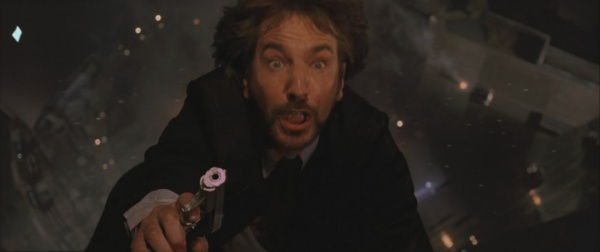
I had planned to write a review of the film Die Hard and talk about the quintessential American-ness of it, and why this wasn't propagandic hero-worship (despite overtly foreign, even Aryan villains), but why the film was in truth an examination of such worship, particularly in the film medium. In short, Die Hard shows that us Americans like our ultimate badasses, and that their super-human qualities expressed through the average Joe has a legitimately positive and inspiring effect on viewers (personified by the Sgt. Powell character).

But then I decided that there was only one sentence in all the world that could effectively and accurately describe the film, and at the (brilliant) urgence of a friend, I let the review stay at that. Here is that sentence in all its concise glory:


In Die Hard, people don't just die -- they super die.

Saturday, January 16, 2010

Snob snob snob

Long time no post. These are, based on my experience and reaction, the most overrated, uninteresting, boring, Oskar Bate films of 2009. I can not grasp or even begin to fathom the praise for them.

Let it be known that I haven’t seen many non-American films this year, because, well I’m a fat American who enjoys all manner of apparatus-flung spheroids.


STAR TREK
I at least get the appeal here, I guess. I enjoy Trek as much as the next nerd, but I’m not really a fan, so that right there detracted from my enjoyment. Even taken on summer movie terms, though, I still found it boring. The production design was fantastic; all the sets, props, and costumes were a joy to look at; but I could never get over the annoying cinematography. So many cuts and close-ups! This is a very dynamic way of shooting films that is a popular trend right now, very Bourne kind of stuff, and I do not think it works for sci-fi. When there’s fantastic technological wonders zipping across the screen, explosions used like most people use punctuation, all the magic is lost. We should be able soak that stuff in, really appreciate the craft and thought gone into their design. Star Trek, to its great detriment, never lets up.

DISTRICT 9
I said all there was to say in my review already, but I think that this film and the other sci-fi duds of the year were so well received because there has been such a shortage of great films in the genre. This drought has people so thirsty that they guzzle down whatever droplets are being produced and think them to be great works.

AVATAR
This could be a trilogy of sorts; “Sci-Fi 2009: When Tastes Dilute.”

UP IN THE AIR
Jason Reitman needs to stop with the musically-edited opening credits sequences. They bother me.

UP
This is the big one. I am so baffled by this film’s love. Am I really such a bastard that I was apparently the only person not moved to tears by this aesthetically-challenged, bland, wheeze of a forgettable film? You’ve got two geezers, for all intents and purposes senile, fighting each other on top of a freaking zeppelin. This should have been incredible! But it wasn't – it was boring. Totally, unforgivably dead on the screen.

Tuesday, December 29, 2009

For All Mankind


For All Mankind is an extraordinary documentary that chronicles the Apollo missions. Director Al Reinert poured over endless amounts of NASA's archival footage to create one of the most inspiring and communal motion pictures ever made. I don't think I can fully articulate this film's invaluability to myself, film in general, or (seriously) mankind, so rather than write my own piece I have a link to an essay by Terrence Rafferty. Read it, have a listen to a bit of Brian Eno's fantastic soundtrack, and then seek out the film for your own viewing. You can watch the film on Criterion's site for a mere five dollars, and I strongly encourage it.


EDIT: I caved and decided to write my own, bad, piece on the film. But it expresses how I was feeling, so that is at least worthy. I am happy.

HAPPY


For All Mankind is an extraordinary chronicle of the Apollo missions. Director Al Reinert poured over endless amounts of NASA’s archival footage to create one of the most unique documentaries ever made. Unlike conventional docs, there are no talking head interviews or camera movement over still photographs. Video is entirely comprised of on location photography by NASA personnel and astronauts, voiced-over by the astronauts themselves. Footage from all the Apollo flights is spliced together to create the sensation of one epic, singular trip. This results in a technically fictitious series of events, but that’s filmmaking. The absence of subtitles to designate who is on-screen or who is speaking creates a humbling anonymity that trivializes the flags and initials emblazoned over the crew and equipment. These aren’t people, but humans.

Can I truly articulate this film’s invaluability? I have watched it every single day since my first viewing, and I can’t wait to watch it again tomorrow. To be there for Armstrong’s famous words, to cower at the terrible, explosive power of liftoff, like some infernal bullet fired from the depths of hell, or to simply marvel at Earth’s, my home’s, beauty. For All Mankind is representative not just of one of our greatest achievements, but of all humanity. You are unlikely to ever see a more inspiring or communal motion picture.

Wednesday, December 23, 2009

Whatever.


Whenever not epitomizing the role himself, Woody Allen has always found appropriate actors to portray his neurotic, obsessive, and pessimistic protagonists. I stress that Allen is the only one really fit for these roles because he is essentially playing himself, but John Cusack seemed to work alright, and now equally neurotic Larry David is giving it a shot, perhaps to better represent Allen’s age. On paper he seems a great fit. What have become known as the “Larry David moments” of Curb Your Enthusiasm could theoretically work well under Allen’s witful direction, but Whatever Works isn’t a film about Larry David moments, despite the actor’s declamatory presence. David’s deliveries feel forced, and his chemistry with the other actors is generally awkward, in such a way that it’s more like watching a screenplay than a movie.

However, I kept wondering whether or not this was intentional. Is the script supposed to feel so obtrusive? Jokes are obvious and by the climax the characters are all tidied up uncharacteristically neatly for an Allen film. David’s character, Boris Yelnikoff, even turns to the audience to deliver a denouement so no one is left behind. He actually breaks the fourth wall frequently throughout the film, each time the rest of the cast, interestingly, aware of his apparent soliloquies, yet unaware of us, the film-watchers. He must look insane, and maybe he is. Boris is frequently named and self-proclaimed a genius, but history has shown that the line between genius and insanity is a fine one. Maybe that’s why he’s such a misanthrope?

This is all too absurd to be taken seriously or at face value, so I’ll give Allen the benefit of the doubt and say he was being subversive. The point? No idea, so I’ll end this review in similar fashion:

Whatever Works? Well, it kind of does. Whatever works for you, Woody.

Monday, December 21, 2009

The Art of Winning


It is not often enough that Criterion releases a thoroughly American production such as this, so I took particular interest in Downhill Racer. A young Gene Hackman coaches an even younger Robert Redford and the USA Olympic Ski Team to victory, but at what cost? Redford’s protagonist, David Chappellet, is a prick: self-righteous and uncompromising in his quest for athletic admiration. Are these truly the qualities of a champion? Chapellet’s rise to the top is fragile. He is for the most part a pawn manipulated by Hackman, bent on realizing his dream of the States gaining acceptance on the global skiing scene. This fresh, if cynical take turns the typical American sports film on its head. The eventual and expected climax is totally unsatisfying, but this is the point. Shouldn’t winning feel good? Thanks to visceral photography and an uneasy tone (the beats are familiar, but it feels like laughing at a joke you know isn’t funny), Downhill Racer paints a gritty, realistic portrait of competition. How one plays the game ultimately doesn’t matter, it seems.


Wednesday, December 16, 2009

This > That > Something Else

item This: Charlie Chaplin's City Lights and its famously ambivalent ending


item That: an equally ambivalent (if less heart-wrenching) ending in Woody Allen's Manhattan. emulation is afoot


item Something Else: the most famous and arguably best segment from Fantasia 2000 illustrates George Gershwin's performance of "Rhapsody in Blue" in classic Hirschfeld style. you can easily deduce the location


yes, that is the same piece that bookends Allen's film. these guys knew what they were doing

Tuesday, December 1, 2009

Reviewy Thingys

BIG-EARED ELEPHANTS ONLY

Some have called this film racist. I think they are misinterpreting. Yes there is a crow named Jim. Yes he and his gang are voiced by members of the all-black Hall Johnson Choir. No, this is not in any way racial derogation. If the fact that the crows are among the only human characters in the film (and I’m not talking anthropomorphism) isn’t enough to disprove the controversy, recall the tent-raising scene:


Dumbo, his mother, and the rest of the elephant troupe hammer stakes into the ground using their trunks. These images are intercut with African-American workers doing the same. Soon after, the circus master whips Mrs. Jumbo for crazed behavior, instigated by teasing directed at her son’s fantastically over-sized ears. The analog is obvious, and speaks volumes. Who are the slaves here? I won’t dwell on the fact that the chief bully’s own ears are quite large, but the hypocrisy is noted.


If anything this film is anti-racist. Prejudice conflicts with the film’s central theme; discovering and learning to love one’s uniqueness, to utilize one’s talents. This is a story of understanding and acceptance. To find any advocacy, let alone traces, of something so hateful, one would have to be looking, and have to be looking hard.

Dumbo is undoubtedly one of Disney’s great works, with its spectacularly simple approach (64 minutes running time, now that’s efficient storytelling) and its universal message. It is such a sadness that some adults seem to have complicated something so clear, something that any child wouldn’t give a second thought. I truly wonder who would benefit more.


IT'S ALIVE!


Now this is a film. A chilling and legitimately terrifying look at science and moral. Boris Karloff is famously tragic in an iconic performance, but the rest of the cast is no less great. Colin Clive in particular pores pathos as the mad Doctor. The expressionist photography (a wise choice, given the Easter-European setting) and gothic set-design give the film an unforgettable atmosphere. The art is moody; full of shadows and dark clouds, all seen at erratic angles. This must be how the monster perceives the world. Sure, it’s no Dr. Caligari – it’s something else. An American classic.


MUPPET MAGIC MINUS THE MUPPETS

A provoking fantasy adventure driven by Henson's puppet wizardry, here in full force. There are no human actors throughout the entire film, and the imaginative world of Thra is all the more enthralling because of it. Every expressive creature, every lush, lived-in locale was crafted by a master and physically, truthfully existed in front of a camera. The Dark Crystal will make you loathe the advent of the computer generated image.

Saturday, November 14, 2009

Upcoming movies

i want to see these


both films open Thanksgiving day. i think we can all agree that their posters are cool

Monday, November 2, 2009

Where the Wild Things Are review


Where the Wild Things Are (2009)
Warner Bros.
directed by Spike Jonze


There is some silliness and perhaps uselessness in adapting a nine sentence picture book into a feature-length film, but the expansion from rise and fall of temper tantrum to an observation on family dynamics and conflict is a worthwhile one. The wild things can be seen as metaphors for Max’s emotions, or his family members, or both. I like the analog to very conflicting, yet very realistic viewpoints most. “It’s hard being a family,” one of the things innocently remarks.


Where the Wild Things Are didn’t do a lot for me, as an adult. The film is best at the beginning, before Max even steps foot on the island. Here it is a genuinely moving meditation on childhood, reminding us that being a kid is pretty awkward and lonely. There is a particularly beautiful moment that captures Max as he, eyes glossy and altogether somewhere else, cascades a toy boat over his sea-blue bed spread.


I was afraid that what I loved about Spike Jonze’s previous films were Charlie Kaufman’s genius screenplays, but I can see now that the man has a talent and an eye for showing things we all understand and feel, but rarely solidify or are even aware of. In this film he has such a grasp on the mind and experience of a child, and I think this is a great one for children to see. Its themes and situations will feel dark, but that’s only because of the general schlock that is deemed worthy for up and coming generations. Compared to most kids’ films, Where the Wild Things Are is master class.


Inglourious Basterds review


Inglourious Basterds
(2009)
The Weinstein Company, Universal Pictures
directed by Quentin Tarantino


Inglourious Basterds
is not a war film. Nor is it historical. Inglourious Basterds is a spaghetti western. Nazi-occupied France is no more than a canvas for Tarantino to scribble his colorful stories and characters. Sometimes the results are insultingly simple doodles, but more often than not they beautifully coalesce into cathartic assaults of aesthetics from the director's encyclopedic mind of movies. History be damned.

Because of this emulation I found the film decidedly more fun than QT's previous efforts. That distinct "movieness" is more present than ever, in large part due to a literally film-oriented plot. Cinema is the McGuffin here, and there were some unsettlingly surreal moments, for me as a viewer, in which the camera paints the characters as audience members themselves.

Though too high-concept and stylized to resonate emotionally, the film left me pondering the deterrence and deception of not only war propaganda, but the figurehead-edness of modern media. During the climax when the film bravely barrages into alternate history (more so than before I mean), consider the alternative; the obvious fabrication is anything but.

Ponyo review


Gake no Ue no Ponyo
Toho (Japan), Walt Disney Pictures (USA)
directed by Hayao Miyazaki


Many have called this a "lesser" work of the master. I prefer "familiar;" Miyazaki's staples are everywhere, such as child protagonists and some light environmental messages (though his signature motif, flight, is notably absent). So Ponyo is pretty much business as usual with Studio Ghibli - business as usual with one of the most consistently creative and charming film studios in the world. Expect beautiful animation (here traditionally hand-drawn), endless expression, and a highly imaginative whimsical romp through the glowing eyes of youth.

Some will find the story simplistic and pointless, but those with an eye for nuance will see Miyazaki's gift for situation and presence on par with his masterful My Neighbor Totoro. I responded best to scenes reminiscent of my own childhood (and others of theirs I'm sure), for instance the respective feather-ruffling of parents or the excitement of exploring a new friend's home. Both were nostalgic illustrations of particular instances I had long forgotten, and am now glad to remember. Because of this focus more still will miss the sweeping epicness of say Laputa or Mononoke, however they will also miss the point. This is thoroughly a family film, its themes paternal and its conflicts relative. See it with your family. Grab some kids and join their wide-eyed ranks for 90 minutes.