I, the great op89x, have joined this blog. I plan to contribute...something. Something wonderful.
Mostly I'll help provide some video game insight while the blog's creator does absolutely nothing.
Tuesday, April 27, 2010

Saturday, April 3, 2010
Pokémon 4.2
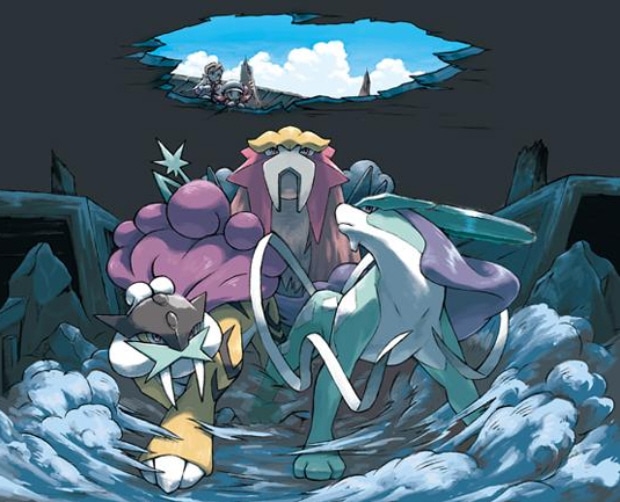
"We are remaking an old game, but this is quite a challenge. Old fans would not want us to mess with their good memories... but there is no point in just redoing the same thing, right? We are working toward something that brings back memories, yet is also completely new!"
Encountering Game Freak's in-game avatars in the Celadon Condominiums is just as surreal as it was ten years ago, but the new text spoken by the company's President strikes me as disclaimer-ey bullshit. This may be a lot of fanboy ranting and nitpicking, but I call fair game. Some of the crap they pulled makes me wonder if the development team ever even played the original Gold and Silver.
For starters, a lot of the polygon-ization doesn't work. While the updated aesthetics are generally pleasant, too many of the 3D models are eyesores. Caves and cliffs are downright ugly, boulders are inconsistently split between pixel-based sprites and polygons, and Gyms resemble planet-sucking, parasitic spaceships. Speaking of the Gyms, I know these are video games and all (JRPGs at that), so arbitrary anachronisms come with the territory, but what is with the interior design of those places? It's not so much the art direction; anyone who's ever played an RPG in their lives is familiar with the overworld/interiors dichotomy; but rather the level design. In what was apparently an attempt to utilize the DS's processing power, each Gym now contains overproduced, pointlessly polygon-based puzzles. Plodding through these is tiresome and annoying -- keeping the old puzzles would have been more than fine. I'm just glad that Kanto and Johto still have their own tree sprites. If they didn't... then I don't know what.
Because that's really the whole point of these games: the contrast of two neighboring lands, each with their own unique culture, unified by those wondrous critters. Kanto is modern; every town brims with the mark of industry and the ease of technology. Celadon and Saffron are the largest cities in the game, and are kept alive by a nearby power plant, the only one in either region. Its importance is evident; until the player restores functionality to the plant, free travel between the regions is impossible, the Magnet Train unable to run without electricity. Perhaps the game's single best expression of Japan's urbanization comes when it is revealed that a family's home was demolished in favor of constructing one of the Magnet Train's stations. Kanto's resident Pokémon reflect this modernization, too: Grimer is said to excrete from industrial waste; Voltorb's discovery postdates the advent of the Poké Ball. Recall the fat man of Pallet Town, his text unchanged since Generation 1: "Technology is incredible!"
Johto is Kanto's illustrious mirror; Johto is historic. Heritage is celebrated everywhere. Buildings are traditionally Japanese, from their visual appearance to the inclusion of the code of etiquette; tiny shoe sprites, set off to the side, are visible in most homes. Ancient pagodas are also maintained in several towns, two of which are central to the story. All five of the original games' legendary Pokémon sprung from these towers. Fitting, because Johto's legendary Pokémon truly were just that; legendary. Tales of these creatures have been passed down for centuries, and are regarded with utmost reverence.
It's saddening, then, that HeartGold and SoulSilver are not the consummate, all-encompassing Pokémon games that Gold and Silver were. The metaphor is barely intact now. In the original Gold and Silver, none of Kanto's legendary Pokémon were present. Their absence was never fully explained, but it perfectly personified Kanto's distance from its own history. Now all of Kanto's legendary Pokémon can be caught. Just as inexplicably, some Hoenn legendaries from Generation 3 have made their way into the game. This would have made much more sense if all of these new Pokémon resided in Johto rather than Kanto, then the beautiful juxtaposition of old and new would have remained, at least in some form. The lowest point of the entire game is the return of Viridian Forest. In Generation 1, Viridian Forest, besides being where Pikachu lived, was the nightmarish first "dungeon" of the game, prepping you for the tough Gym battle ahead. In Generation 2, upon discovering that Kanto was playable in this Generation as well, my heart leapt at the thought of nostalgically retreading familiar ground -- but the painful memories of Viridian Forest distressed the back of my mind. When I finally summoned the bravery to revisit that hellish grove, though, I was greeted with an incredible development: the forest had been cleared! Consistent with the ever-expanding Kanto, Viridian Forest was now nothing more than a few harmless patches of grass. I remember the music clearly: an ingenious remix of the original Viridian Forest theme, but after the first few disjointing chords, a brand new infectiously sweet melody took over, signifying the change. In HeartGold and SoulSilver, with the forest appearing as it did in Generation 1, the most grotesque retcon of all time has taken place. Both the meaning and my memories have been hacked away, but the remix (now a remix of a remix), only furthering the craziness, remains.
The real head-scratcher is the fact that all of this needless addition came at the expense of actual logical implementation, namely of some key features from Generation 3. Both that generation's berry and meme systems are in HeartGold in SoulSilver, but in a cripplingly limited fashion. Every fruit-bearing tree in the game is now an apricorn tree; there are no trees that produce berries on the overworld. This makes absolutely no sense, and is boring, lazy game design. Berries are now restricted to a key item, operational only through a menu. The meme system is really no more than a cameo reference. Remember those wacky, yet effortlessly profound NPC responses from Ruby, Sapphire, and Emerald? (some of my personal favorites: HAS DANCE, LIFE LESSONS, STOCK PRICES) Yeah, they're gone. But it's more cool this way. The more legendaries and useless features a Pokémon game has, the better. All in the name of fan-service, right?
It is so strange to think that in a little more than a decade, a weird RPG about bug-catching on the Game Boy, glitchy as hell and full of poor localization (did it ever occur to anyone how racist the name Porygon is, or why there exist female Mr. Mime?), has become the behemoth that we know it today. What many surely wrote off as a cultural oddity and no more than the latest marketing phenomenon, was for many kids of the right age, a way of life. But at the core of the cult, before the anime and the trading cards and the mountains of merchandise, there was a handful of great video games. The Gold and Silver versions were for a lot of fans the best the series ever got, and Nintendo's lowest common denominator remakes bank more on nostalgia than anything else. Indeed, on the whore, these remakes are about the worst that they could have been... but damned if I haven't already put 80 hours into my adventure. It's painfully obvious that these games came more out of necessity than passion; it makes sense for Nintendo to want every single Pokémon available in a single generation, so the magic of the original Gold and Silver isn't really there... but most of the fun is. It's still Pokémon, and I will always, always love Pokémon.
"If you treat your Pokémon nicely, they will love you in return."
LIFE LESSONS, people. LIFE LESSONS.
Encountering Game Freak's in-game avatars in the Celadon Condominiums is just as surreal as it was ten years ago, but the new text spoken by the company's President strikes me as disclaimer-ey bullshit. This may be a lot of fanboy ranting and nitpicking, but I call fair game. Some of the crap they pulled makes me wonder if the development team ever even played the original Gold and Silver.
For starters, a lot of the polygon-ization doesn't work. While the updated aesthetics are generally pleasant, too many of the 3D models are eyesores. Caves and cliffs are downright ugly, boulders are inconsistently split between pixel-based sprites and polygons, and Gyms resemble planet-sucking, parasitic spaceships. Speaking of the Gyms, I know these are video games and all (JRPGs at that), so arbitrary anachronisms come with the territory, but what is with the interior design of those places? It's not so much the art direction; anyone who's ever played an RPG in their lives is familiar with the overworld/interiors dichotomy; but rather the level design. In what was apparently an attempt to utilize the DS's processing power, each Gym now contains overproduced, pointlessly polygon-based puzzles. Plodding through these is tiresome and annoying -- keeping the old puzzles would have been more than fine. I'm just glad that Kanto and Johto still have their own tree sprites. If they didn't... then I don't know what.
Because that's really the whole point of these games: the contrast of two neighboring lands, each with their own unique culture, unified by those wondrous critters. Kanto is modern; every town brims with the mark of industry and the ease of technology. Celadon and Saffron are the largest cities in the game, and are kept alive by a nearby power plant, the only one in either region. Its importance is evident; until the player restores functionality to the plant, free travel between the regions is impossible, the Magnet Train unable to run without electricity. Perhaps the game's single best expression of Japan's urbanization comes when it is revealed that a family's home was demolished in favor of constructing one of the Magnet Train's stations. Kanto's resident Pokémon reflect this modernization, too: Grimer is said to excrete from industrial waste; Voltorb's discovery postdates the advent of the Poké Ball. Recall the fat man of Pallet Town, his text unchanged since Generation 1: "Technology is incredible!"
Johto is Kanto's illustrious mirror; Johto is historic. Heritage is celebrated everywhere. Buildings are traditionally Japanese, from their visual appearance to the inclusion of the code of etiquette; tiny shoe sprites, set off to the side, are visible in most homes. Ancient pagodas are also maintained in several towns, two of which are central to the story. All five of the original games' legendary Pokémon sprung from these towers. Fitting, because Johto's legendary Pokémon truly were just that; legendary. Tales of these creatures have been passed down for centuries, and are regarded with utmost reverence.
It's saddening, then, that HeartGold and SoulSilver are not the consummate, all-encompassing Pokémon games that Gold and Silver were. The metaphor is barely intact now. In the original Gold and Silver, none of Kanto's legendary Pokémon were present. Their absence was never fully explained, but it perfectly personified Kanto's distance from its own history. Now all of Kanto's legendary Pokémon can be caught. Just as inexplicably, some Hoenn legendaries from Generation 3 have made their way into the game. This would have made much more sense if all of these new Pokémon resided in Johto rather than Kanto, then the beautiful juxtaposition of old and new would have remained, at least in some form. The lowest point of the entire game is the return of Viridian Forest. In Generation 1, Viridian Forest, besides being where Pikachu lived, was the nightmarish first "dungeon" of the game, prepping you for the tough Gym battle ahead. In Generation 2, upon discovering that Kanto was playable in this Generation as well, my heart leapt at the thought of nostalgically retreading familiar ground -- but the painful memories of Viridian Forest distressed the back of my mind. When I finally summoned the bravery to revisit that hellish grove, though, I was greeted with an incredible development: the forest had been cleared! Consistent with the ever-expanding Kanto, Viridian Forest was now nothing more than a few harmless patches of grass. I remember the music clearly: an ingenious remix of the original Viridian Forest theme, but after the first few disjointing chords, a brand new infectiously sweet melody took over, signifying the change. In HeartGold and SoulSilver, with the forest appearing as it did in Generation 1, the most grotesque retcon of all time has taken place. Both the meaning and my memories have been hacked away, but the remix (now a remix of a remix), only furthering the craziness, remains.
The real head-scratcher is the fact that all of this needless addition came at the expense of actual logical implementation, namely of some key features from Generation 3. Both that generation's berry and meme systems are in HeartGold in SoulSilver, but in a cripplingly limited fashion. Every fruit-bearing tree in the game is now an apricorn tree; there are no trees that produce berries on the overworld. This makes absolutely no sense, and is boring, lazy game design. Berries are now restricted to a key item, operational only through a menu. The meme system is really no more than a cameo reference. Remember those wacky, yet effortlessly profound NPC responses from Ruby, Sapphire, and Emerald? (some of my personal favorites: HAS DANCE, LIFE LESSONS, STOCK PRICES) Yeah, they're gone. But it's more cool this way. The more legendaries and useless features a Pokémon game has, the better. All in the name of fan-service, right?
It is so strange to think that in a little more than a decade, a weird RPG about bug-catching on the Game Boy, glitchy as hell and full of poor localization (did it ever occur to anyone how racist the name Porygon is, or why there exist female Mr. Mime?), has become the behemoth that we know it today. What many surely wrote off as a cultural oddity and no more than the latest marketing phenomenon, was for many kids of the right age, a way of life. But at the core of the cult, before the anime and the trading cards and the mountains of merchandise, there was a handful of great video games. The Gold and Silver versions were for a lot of fans the best the series ever got, and Nintendo's lowest common denominator remakes bank more on nostalgia than anything else. Indeed, on the whore, these remakes are about the worst that they could have been... but damned if I haven't already put 80 hours into my adventure. It's painfully obvious that these games came more out of necessity than passion; it makes sense for Nintendo to want every single Pokémon available in a single generation, so the magic of the original Gold and Silver isn't really there... but most of the fun is. It's still Pokémon, and I will always, always love Pokémon.
"If you treat your Pokémon nicely, they will love you in return."
LIFE LESSONS, people. LIFE LESSONS.
Monday, March 29, 2010
Crisis
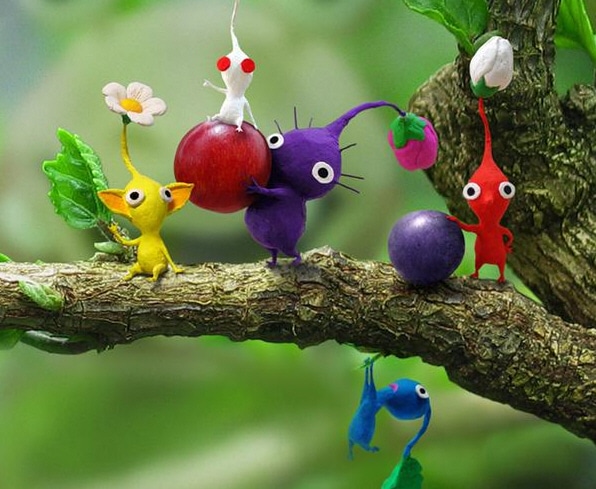
People underestimate this game. It's the closest Shigeru Miyamoto has ever (at least consciously) come to being an artist, and not an entertainer. His words, by the way -- no one pitch a "games are art" fit. Think of the game as a magnifying glass over the tiniest of ecosystems, with the struggle to survive at least equally (though probably more like exponentially) magnified. When things like bottle caps and puddles pose obstacles to your ever growing populous, and the local bullies are creepy-crawlers of prehistoric proportions, it's an eye-opening shift in perspective, to say the least. There's a reason I still haven't finished the game: I fear for my Pikmin. I don't want them to get lost, or drown, or be maimed by a Cretaceous caterpillar.
I've never experienced that fear (or anything comparable in emotional extremity) while playing similar population-management games. In the likes of Sim City and Roller Coaster Tycoon, it's quite often more fun to cause as much destruction as possible, rather than attempt completion of the quota. Not so in Pikmin. Maybe it's the setting, the injection of biology into a genre that is almost always urban or militarized, and whose usual focus is gluttonous micro-management... but Pikmin is for whatever indeterminable reason, more pathological. We know that Miyamoto was inspired by the "tiny worlds" he found in his garden. The result (as much as I hate the "E" word) is an almost existential examination of life. Or maybe mid-life is more appropriate, given Miyamoto's age, and player-character Captain Olimar's preoccupation with family. Not to mention the game's ticking clock. One of my favorite game overs ever, honestly: if marooned Olimar can't escape the deadly atmosphere in under 30 days, he dies. Most people buy a sports car; this genius made a real time strategy game about ecology and primary-colored bugs.
I've never experienced that fear (or anything comparable in emotional extremity) while playing similar population-management games. In the likes of Sim City and Roller Coaster Tycoon, it's quite often more fun to cause as much destruction as possible, rather than attempt completion of the quota. Not so in Pikmin. Maybe it's the setting, the injection of biology into a genre that is almost always urban or militarized, and whose usual focus is gluttonous micro-management... but Pikmin is for whatever indeterminable reason, more pathological. We know that Miyamoto was inspired by the "tiny worlds" he found in his garden. The result (as much as I hate the "E" word) is an almost existential examination of life. Or maybe mid-life is more appropriate, given Miyamoto's age, and player-character Captain Olimar's preoccupation with family. Not to mention the game's ticking clock. One of my favorite game overs ever, honestly: if marooned Olimar can't escape the deadly atmosphere in under 30 days, he dies. Most people buy a sports car; this genius made a real time strategy game about ecology and primary-colored bugs.
Saturday, March 13, 2010
Final Fantasy XIII impressions
The major theme here seems to be duty; upholding and fulfilling predetermined roles. This is seen in both the story and the battle system. That is the mark of a good game, when the rules and the narrative express the same ideas.
For instance, the l'Cie are these martyrs, right? Straying from their path results in "death," and completing it results in "death." Contrast this with the notion of the Cocoon citizens: a society so sheltered and constructed that open-minded thought is pretty much impossible; not living up to your expected role here is again, deadly. On the gameplay side, you've got this battle system which revolves around assigning and mismatching "roles" for the characters to fulfill. It strikes me as a juxtaposition and melding of two paradigms: the old school Final Fantasies (pre VII), and the newer ones (post VII). Old FF required players to utilize different characters' predetermined unique stats efficiently, by pairing compatible classes. New FF essentially turned characters into blank slates, to be customized entirely by the player. The fact that Final Fantasy VII was indeed a paradigm shift for the series, coupled with the (almost) painfully obvious and copious references to that game found in XIII, to the point that I'm not sure XIII isn't some strange secret remake, well... it makes me think.
Now, I'm still really early, but the inevitability is that at some point in the game, the cast will make it off of the technological, floating wonder that is Cocoon (or was it Midgar?), and onto the lurking wild below, opening up a whole new world of gameplay options and possibilities. Gone will be the pandering tutorials and sterility of party management. There will a breaking out of the shell, a shedding of the skin of such fantastic proportions...
... oh.
OH. I see what you did there, Square-Enix. Nice metaphor.
For instance, the l'Cie are these martyrs, right? Straying from their path results in "death," and completing it results in "death." Contrast this with the notion of the Cocoon citizens: a society so sheltered and constructed that open-minded thought is pretty much impossible; not living up to your expected role here is again, deadly. On the gameplay side, you've got this battle system which revolves around assigning and mismatching "roles" for the characters to fulfill. It strikes me as a juxtaposition and melding of two paradigms: the old school Final Fantasies (pre VII), and the newer ones (post VII). Old FF required players to utilize different characters' predetermined unique stats efficiently, by pairing compatible classes. New FF essentially turned characters into blank slates, to be customized entirely by the player. The fact that Final Fantasy VII was indeed a paradigm shift for the series, coupled with the (almost) painfully obvious and copious references to that game found in XIII, to the point that I'm not sure XIII isn't some strange secret remake, well... it makes me think.
Now, I'm still really early, but the inevitability is that at some point in the game, the cast will make it off of the technological, floating wonder that is Cocoon (or was it Midgar?), and onto the lurking wild below, opening up a whole new world of gameplay options and possibilities. Gone will be the pandering tutorials and sterility of party management. There will a breaking out of the shell, a shedding of the skin of such fantastic proportions...
... oh.
OH. I see what you did there, Square-Enix. Nice metaphor.
Western Funeral

Once Upon a Time in the West is the greatest Western ever made, and by extension, one of the greatest films ever made. Actually, even though I have a strong hatred for such silly hyperbolic phrases (despite said phrases having become common subjects and methods of classification), Once Upon a Time in the West may be the greatest Western of all time. There are grounds for this. First of all, I doubt there will ever be a director who loved or understood the genre more than Sergio Leone. The Italian's fascination with and awe of American culture was epitomized by the glorification of the time period; the Old West had become modern mythology. There is a chivalry to the cowboy, and a fantasy to the frontier. Leone idolized it all.
"In my childhood, America was like a religion. Then, real-life Americans abruptly entered my life in Jeeps and upset all my dreams."
That's the other reason a better Western is unlikely to ever exist, and what the film is really about: the death of the myth. West was almost topical in the way it combined and referenced so many of the genre's staples. The opening credits sequence re-imagines the train scene from High Noon, except in West, the three characters waiting for the train are gunned down within minutes. There is even a small reference to Leone's previous film (and one of his three masterpieces), The Good, the Bad and the Ugly. One of the three men famously filled the frame of that film's opening shot, and remember the stray dog that intercut that first shot? He's back, too. Legend has it that Leone even intended Clint Eastwood, Lee Van Cleef, and Eli Wallach to play the three men at the beginning of West. The shock of their deaths so early in the film would have perfectly symbolized the deconstruction of the genre, especially since Van Cleef was also one of the original three in High Noon. The man knew what he was doing.
"In my childhood, America was like a religion. Then, real-life Americans abruptly entered my life in Jeeps and upset all my dreams."
That's the other reason a better Western is unlikely to ever exist, and what the film is really about: the death of the myth. West was almost topical in the way it combined and referenced so many of the genre's staples. The opening credits sequence re-imagines the train scene from High Noon, except in West, the three characters waiting for the train are gunned down within minutes. There is even a small reference to Leone's previous film (and one of his three masterpieces), The Good, the Bad and the Ugly. One of the three men famously filled the frame of that film's opening shot, and remember the stray dog that intercut that first shot? He's back, too. Legend has it that Leone even intended Clint Eastwood, Lee Van Cleef, and Eli Wallach to play the three men at the beginning of West. The shock of their deaths so early in the film would have perfectly symbolized the deconstruction of the genre, especially since Van Cleef was also one of the original three in High Noon. The man knew what he was doing.

Subscribe to:
Posts (Atom)