Monday, March 29, 2010

Crisis


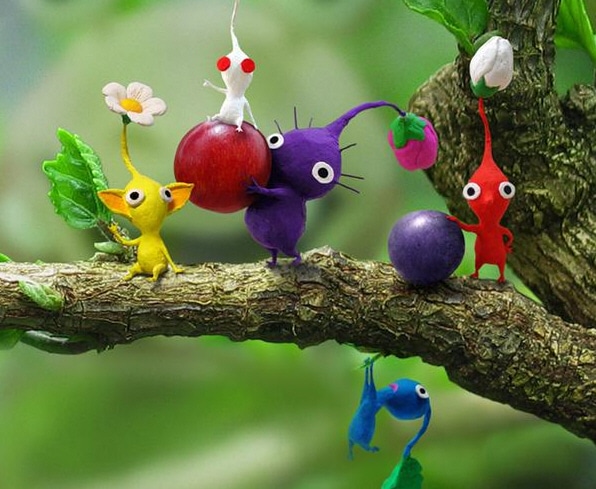
People underestimate this game. It's the closest Shigeru Miyamoto has ever (at least consciously) come to being an artist, and not an entertainer. His words, by the way -- no one pitch a "games are art" fit. Think of the game as a magnifying glass over the tiniest of ecosystems, with the struggle to survive at least equally (though probably more like exponentially) magnified. When things like bottle caps and puddles pose obstacles to your ever growing populous, and the local bullies are creepy-crawlers of prehistoric proportions, it's an eye-opening shift in perspective, to say the least. There's a reason I still haven't finished the game: I fear for my Pikmin. I don't want them to get lost, or drown, or be maimed by a Cretaceous caterpillar.

I've never experienced that fear (or anything comparable in emotional extremity) while playing similar population-management games. In the likes of Sim City and Roller Coaster Tycoon, it's quite often more fun to cause as much destruction as possible, rather than attempt completion of the quota. Not so in Pikmin. Maybe it's the setting, the injection of biology into a genre that is almost always urban or militarized, and whose usual focus is gluttonous micro-management... but Pikmin is for whatever indeterminable reason, more pathological. We know that Miyamoto was inspired by the "tiny worlds" he found in his garden. The result (as much as I hate the "E" word) is an almost existential examination of life. Or maybe mid-life is more appropriate, given Miyamoto's age, and player-character Captain Olimar's preoccupation with family. Not to mention the game's ticking clock. One of my favorite game overs ever, honestly: if marooned Olimar can't escape the deadly atmosphere in under 30 days, he dies. Most people buy a sports car; this genius made a real time strategy game about ecology and primary-colored bugs.

Saturday, March 13, 2010

Final Fantasy XIII impressions


The major theme here seems to be duty; upholding and fulfilling predetermined roles. This is seen in both the story and the battle system. That is the mark of a good game, when the rules and the narrative express the same ideas.

For instance, the l'Cie are these martyrs, right? Straying from their path results in "death," and completing it results in "death." Contrast this with the notion of the Cocoon citizens: a society so sheltered and constructed that open-minded thought is pretty much impossible; not living up to your expected role here is again, deadly. On the gameplay side, you've got this battle system which revolves around assigning and mismatching "roles" for the characters to fulfill. It strikes me as a juxtaposition and melding of two paradigms: the old school Final Fantasies (pre VII), and the newer ones (post VII). Old FF required players to utilize different characters' predetermined unique stats efficiently, by pairing compatible classes. New FF essentially turned characters into blank slates, to be customized entirely by the player. The fact that Final Fantasy VII was indeed a paradigm shift for the series, coupled with the (almost) painfully obvious and copious references to that game found in XIII, to the point that I'm not sure XIII isn't some strange secret remake, well... it makes me think.

Now, I'm still really early, but the inevitability is that at some point in the game, the cast will make it off of the technological, floating wonder that is Cocoon (or was it Midgar?), and onto the lurking wild below, opening up a whole new world of gameplay options and possibilities. Gone will be the pandering tutorials and sterility of party management. There will a breaking out of the shell, a shedding of the skin of such fantastic proportions...

... oh.

OH. I see what you did there, Square-Enix. Nice metaphor.

Western Funeral


Once Upon a Time in the West is the greatest Western ever made, and by extension, one of the greatest films ever made. Actually, even though I have a strong hatred for such silly hyperbolic phrases (despite said phrases having become common subjects and methods of classification), Once Upon a Time in the West may be the greatest Western of all time. There are grounds for this. First of all, I doubt there will ever be a director who loved or understood the genre more than Sergio Leone. The Italian's fascination with and awe of American culture was epitomized by the glorification of the time period; the Old West had become modern mythology. There is a chivalry to the cowboy, and a fantasy to the frontier. Leone idolized it all.

"In my childhood, America was like a religion. Then, real-life Americans abruptly entered my life in Jeeps and upset all my dreams."

That's the other reason a better Western is unlikely to ever exist, and what the film is really about: the death of the myth. West was almost topical in the way it combined and referenced so many of the genre's staples. The opening credits sequence re-imagines the train scene from High Noon, except in West, the three characters waiting for the train are gunned down within minutes. There is even a small reference to Leone's previous film (and one of his three masterpieces), The Good, the Bad and the Ugly. One of the three men famously filled the frame of that film's opening shot, and remember the stray dog that intercut that first shot? He's back, too. Legend has it that Leone even intended Clint Eastwood, Lee Van Cleef, and Eli Wallach to play the three men at the beginning of West. The shock of their deaths so early in the film would have perfectly symbolized the deconstruction of the genre, especially since Van Cleef was also one of the original three in High Noon. The man knew what he was doing.

Saturday, February 27, 2010

Heavy Rain demo impressions


Heavy Rain is an interactive movie thing. The game is interesting, but stupid. The controls are weird. You don't control these people so much as you "direct" them, giving indications of where and when to walk and turn, and dictating conversations by choosing different emotions. This might have worked, but filling the shoes of a film director is not properly represented. From what I can tell, the game doesn't really require the player to make tough decisions, even though it would appear so. It's disguise; disgusting deception. I replayed the demo several times, and I tried so hard to deviate from the intended course, but it was impossible. The game only allows you to make choices at very specific times, which of course is not real choice at all. There is even a sequence where a guy has an asthma attack, and you are required to sequentially input buttons to save him. I decided to let him suffer. Well, nothing happens. The animation loops over and over. The sequence is only there for the player to feel "immersed," but the player has no real consequential input. Lame. In the end I wound up trying to kill my character in whatever way possible, to unearth any trace of consequence. There was none. Good game design deigns that the player character and the goals required for progression carry a certain amount of interest to the player. A good (and ancient) way of doing this is challenge; the player cares about what happens in-game because of negative feedback. There is no discernible challenge in Heavy Rain.

So Heavy Rain pretty much fails as a game. At even a basic level it is a conflicted mess. Then how about as a movie? Not any better. The character models are horrendously animated. Metal Gear Solid 4 had millions of cutscenes, but at least the characters animated well and successfully emoted. The characters of Heavy Rain live in the deepest regions of the uncanny valley. Motions are generally stiff, facial expressions are... just plain weird, but most importantly, the eyes are dead and wooden. Eyes are so, so important in animation. They are the single most expressive part of character, and one of an animator's greatest tools of emotion. Even Disney figured this shit out decades ago, I don't know what the deal is with Heavy Rain. Really no excuse. And when judged on cinematographic levels, compared to "real" films, Heavy Rain's camera work is boring and stilted. Shots have zero compositional value; there is no intelligence behind the placement and framing. If you're going to make a game that is deeply rooted in cinematic style, you should probably know a thing or two about filmmaking, first. This is why Kojima's games actually work; the guy is a filmic obsessive. Too bad his unique style has become trend.

Obviously I haven't played the full game, so I can't give a full opinion. Maybe all of these problems work themselves out, but I doubt it. The only intention I can think the game developers had was to create an immersive experience. This is a terrible reason to make a game, because the result is cheap and manipulative. This isn't an intelligent, moral-driven adventure; it's a glorified quick time event that manipulates the player. Ironically, the best way to sum up Heavy Rain is it that pushes players' buttons; the player becomes the quick time event, with their emotions as the timed button sequences. This makes for a possibly immersive and intense experience, but in the end is insultingly shallow, a shallowness that I think will be revealed in time as the game is replayed. I admire the game for trying something new, and having read interviews with David Cage and getting to understand his game design philosophies, he seems like a noble enough guy with good intentions. He cares about games as an art form and wants to see them evolve into something special. But if this is the future of interactive media, then there will never be an art form. The entire medium will be artistically dead in a few years.

Shenmue was better at this sort of thing. At least in that game you were given an interesting world that you were encouraged to explore. Not to mention the controls made sense. And that was 10 years ago!

Friday, February 26, 2010

Institutionalization


Shutter Island is a film about a man at war with himself. The mental hospital in which the story takes place is said to have been constructed during the Civil War, and the freakishly enigmatic "Ward C" (where the really crazy ones are kept) was a fort in that war. Ben Kingsley as Dr. Cawley even remarks on the state of psychiatric study: a polarized philosophic mess of old and new ideologies. Internal conflict. So, it's the usual for a psychological thriller, except this time, it's Scorsese-fied.

Scorsese and DiCaprio have made a super-charged genre picture. Because of this, some will find the film cliche and too close to the mark. They wouldn't be wrong, but they'd be missing the point. Nitpicking the plot of any film is a tremendous waste of time. A film's aesthetics are far more important than its literature, and that above all else seems to be the focus of Shutter Island. Sure, you could list off references to past thrillers (I even flashbacked to Skull Island, of all things, during the opening scene), most notably those of the master himself. Both Scorsese and DiCaprio have cited Vertigo as a major influence, and indeed, the tale of a haunted man warped by his memories of a (blonde) woman isn't simply similar. But also remember Hitchcock's mantras of cinema: not as "a slice of life, but a piece of cake," and "technique over content."

And oh, such technique, such style. Scorsese has long been acknowledged as a wizard of of the camera, but I find his utilization and mastery of modern film making techniques downright astounding, especially his humblingly efficient use of computer generated special effects. Can you imagine The Aviator without the glossy galvanization of the crash sequence, or the ridiculous realization of the H-4's liftoff? I can't. Shutter Island is not without equally impossible visual wonders. The psyche is home to many elaborate and surreal dream sequences (or hallucinations... who knows!), including the converged perceptions of misrememberings, and the confetti-like, atmospheric, ashy remains of a fire victim, not really affected by gravity, but listless and tormenting.

Also, maybe it was just me, but I found this film to be a joyous playground of motifs. The final shot is a quiet pan over the island's craggy, New England cliffside, settling on the lone image of a lighthouse, a symbol of guidance. This is also the place where the facility performs lobotomies. Chilling! Especially when considered alongside the title itself: the light of memories hidden, even erased, by the quick and easiness of a shutter.